CALL FOR ABSTRACTS AND PAPERS ON OCEAN SCIENCE
Climate Change Research, Ocean Observations & Advanced Technologies for Regional Sustainability Attending Countries EU Member States, Russia, US, Others invited SponsorsEnvironmental Protection Agency (Lithuania), Coastal Research and Planning Institute, Klaipeda University (Lithuania),Institute of Electrical and Electronics Engineers’, Oceanic Engineering Society (OES); Others invited Symposium Organizers Symposium Chairmen: U. S. Chair: Jerry C. Carroll, President IEEE Oceanic Engineering Society ([email protected]); U.S. Co-Chair: Joseph R. Vadus, Past Vice President, IEEE Oceanic Engineering Society ([email protected]); EU Chair: Dr. Algirdas Stankevicius, Director, Department of Marine Research (DMR), Environmental Protection Agency ([email protected]); EU Co-Chair: Dr. Saulius Gulbinskas, Vice Director of the Coastal Research and Planning Institute, Klaipeda University ([email protected]); Finance Chairman: James Barbera, Past President, IEEE/OES ([email protected]);Finance Co-Chair: Ingrida Sersnioviene, Association “Baltic valley” ingrida.sersnioviene@balticvalley.lt U.S.Technical Program Chairs: Dr Albert J. Williams III, Woods Hole Oceanographic Institution, ([email protected]) & Prof. Victor Klemas, University of Delaware, ([email protected]); EU Technical Program Chairs: Sergej Suzdalev, ([email protected]);Nijole Remeikaite-Nikiene, ([email protected]) International Technical Program Advisors (invited):Prof. Juri Elken, Chair of Third Symposium In Tallinn, Estonia (2008)Prof. Andris Andrusaitis, Chair of Fourth Symposium in Riga, Latvia (2010)Dr. Hans Dahlin,Director, Euro GOOS (Sweden)Dr. Erik Buch, Danish Meteorological Institute (Denmark)Dr. Vadim Paka, P.P. Shirshov Institute of Oceanology, Kaliningrad (Russia) Program Tracks & Suggested Topics Climate Change Research: Operational Monitoring of Physical, Chemical, Biological Parameters; Water Quality; Real Time Measurements; Remote Sensing; Modeling; Ocean Dumping; Pollution Control; Satellite Measurements; Global and Baltic Monitoring Programs; Monitoring Systems; Drifting Buoy Networks. Integrated Ocean Observation Systems: Global Ocean Observation Systems; Baltic Ocean Observation Systems; Euro GOOS; NOOS; GEOSS; Remote Sensing; Real Time Measurements; Monitoring Systems; Data Collection, Analysis & Distribution; Data Standards & Calibration; Modeling. Ecosystem-Based Management: Sustainable Development; Protection and Restoration; Remediation; Geographic Information Systems; Charting Coasts and Waterways; Cooperative Research Projects. Marine Ecosystem Research: Fate of Pollutants; Run-Off Pollution; Sediment Transport & Analyses; Ocean Dumping; Oil spills and Hazardous Material; Eutrophication; Marine Biodiversity; Bio- Sensors; Natural Hazards, Dumped chemical weapon. Advanced Environmental Technologies: Oceanographic Measurements (Current, Wave, CTD, Tidal); Sampling Techniques (Water, Chemistry, Sediment); Acoustic Techniques; Integrated Systems; Oil Spill Measurements & Modeling; Instrument Platforms; Satellite Systems; ROV’s & AUV’s; Gliders; Profiling Floats; Drifting Buoys. Activity in the sea: Renewable Energy; Gas pipelines; Fate of Munitions dumped at sea; Other activity. Symposium Objectives To Discuss and Exchange Information in support of climate change research and ocean observation systems to insure sustainable development: vProblems, Needs, Requirements & Solutions;vAdvances in Application of New Technologies; vPromote Cooperative Projects Background for Prospective Authors The Fifth Baltic International Symposium once again returns to Klaipeda, Lithuania. The first and the second were held in Klaipeda in 2004 and in 2006. The third invited all to Tallinn, Estonia in 2008, and the fourth to Riga, Latvia in 2010. On average the attendance was 200 scientists, engineers and administrators representing 20 countries. A sample copy of past program information can be seen in http://ieeexplore.ieee.org/xpl/mostRecentIssue.jsp?punumber=5609070 The Baltic Sea is a valuable natural resource shared by nine countries bordering its waters. It provides marine resources, transportation corridors, marine recreation, tourism and desirable coastal living. Economic benefits are dependent on a clean environment. The Baltic Sea is 422,000 sq. km. with a relatively shallow average depth of 55 meters. The nine countries, bordering the Baltic Sea are working closely together in continuous monitoring of the Baltic Ecosystem, sharing research and environmental data in order to detect and assess changes that may impact environmental health. Other EU Nations and the U.S. have similar needs and many research programs addressing coastal and global environmental problems, and they can exchange information and experience with the Baltic Nations. Integrated Ocean Observation Systems provide an overarching mechanism to incorporate research and technology projects and systems to facilitate ecosystem-based management. Environmental protection policies are based on a sustainable development approaches. Cleaning the Baltic Sea, preserving biodiversity and monitoring long range transboundary pollution are of great importance. Baltic nations boast many protected coastal areas that also serve as parks and recreational areas. Call for Papers You are invited to send a one-page abstract addressing one of the suggested topics. Early submittal is suggested because of program size limitations.Upload your abstracts in the website http://corpi.ku.lt/ocean2012/by November 1, 2011 Registration Fee The registration fee for participating in the Symposium is 120 EURO (60 EURO for students). The registration fee includes: ice breaker reception; access to the cafeteria; symposium's programme schedule and symposium's documents; attendance at all plenary sessions and work sessions. Travel and accommodation costs are not included in the registration fee. Symposium Documents The planned output of Symposium will be: the abstracts on paper or CD; and the proceedings of selected Symposium papers on CD. Official LanguageThe official language for the symposium will be English. No translation will be provided. Meeting Point & Accommodation The Symposium will take place in Klaipėda, in the Klaipėda University (Services Complex „Studentas”). Participants of the Symposium should make accommodations by themselves. Reservation and more detailed information about Klaipeda hotels are on the Internet: http://www.lithuanianhotels.com/ci ties/Klaipeda. The reservation should be made in advance, because there may be few vacancies during the warm season, beginning in April.Hotels and their names, which are in 1-2 km distance from the meeting point are marked on the map. The Amberton Klaipeda Hotel is recommended as primary hotel. Walking to the University takes about 15 minutes and a morning and an evening bus shuttle will be arranged. *****The Web Site is <http://corpi.ku.lt/ocean2012/>
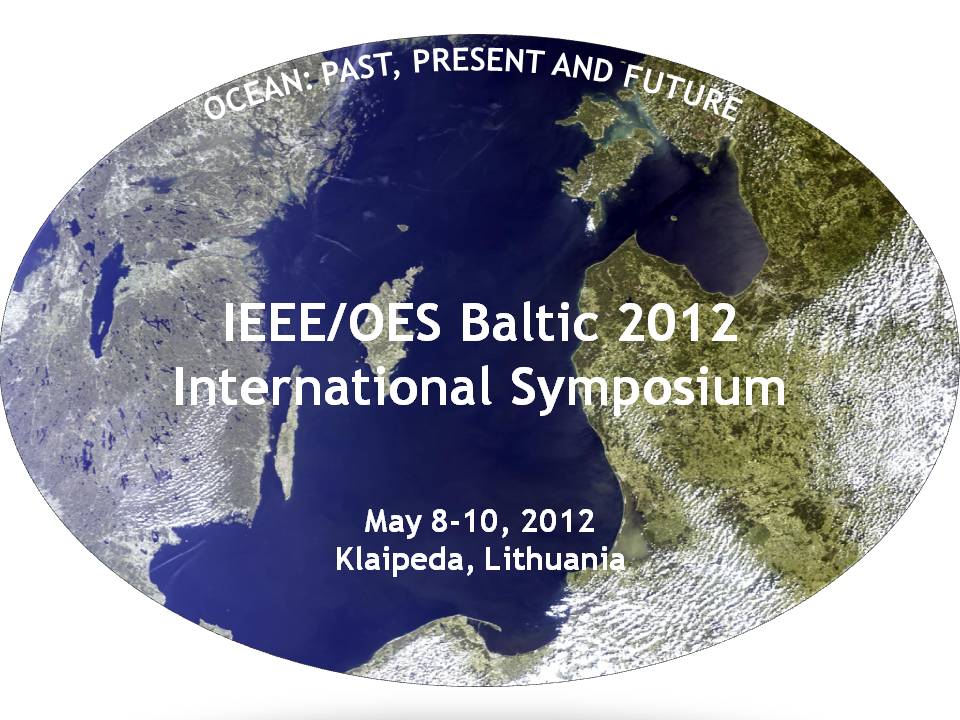
Climate Change Research, Ocean Observations & Advanced Technologies for Regional Sustainability
Attending Countries
EU Member States, Russia, US, Others invited
Sponsors
Environmental Protection Agency (Lithuania),
Coastal Research and Planning Institute, Klaipeda University (Lithuania),
Institute of Electrical and Electronics Engineers’, Oceanic Engineering Society (OES); Others invited
Symposium Organizers
Symposium Chairmen: U. S. Chair: Jerry C. Carroll, President IEEE Oceanic Engineering Society (jerrycortez@charter.net); U.S. Co-Chair: Joseph R. Vadus, Past Vice President, IEEE Oceanic Engineering Society (j.vadus@ieee.org); EU Chair: Dr. Algirdas Stankevicius, Director, Department of Marine Research (DMR), Environmental Protection Agency (a.stankevicius@aaa.am.lt); EU Co-Chair: Dr. Saulius Gulbinskas, Vice Director of the Coastal Research and Planning Institute, Klaipeda University (saulius@corpi.ku.lt);
Finance Chairman: James Barbera, Past President, IEEE/OES (j.barbera@ieee.org);
Finance Co-Chair: Ingrida Sersnioviene, Association “Baltic valley” ingrida.sersnioviene@balticvalley.lt
U.S.Technical Program Chairs: Dr Albert J. Williams III, Woods Hole Oceanographic Institution, (awilliams@whoi.net) & Prof. Victor Klemas, University of Delaware, (klemas@udel.edu);
EU Technical Program Chairs: Sergej Suzdalev, (suzdalev@corpi.ku.lt);
Nijole Remeikaite-Nikiene, (n.remeikaite@aaa.am.lt)
International Technical Program Advisors (invited):
Prof. Juri Elken, Chair of Third Symposium In Tallinn, Estonia (2008)
Prof. Andris Andrusaitis, Chair of Fourth Symposium in Riga, Latvia (2010)
Dr. Hans Dahlin,Director, Euro GOOS (Sweden)
Dr. Erik Buch, Danish Meteorological Institute (Denmark)
Dr. Vadim Paka, P.P. Shirshov Institute of Oceanology, Kaliningrad (Russia)
Program Tracks & Suggested Topics
Climate Change Research: Operational Monitoring of Physical, Chemical, Biological Parameters; Water Quality; Real Time Measurements; Remote Sensing; Modeling; Ocean Dumping; Pollution Control; Satellite Measurements; Global and Baltic Monitoring Programs; Monitoring Systems; Drifting Buoy Networks.
Integrated Ocean Observation Systems: Global Ocean Observation Systems; Baltic Ocean Observation Systems; Euro GOOS; NOOS; GEOSS; Remote Sensing; Real Time Measurements; Monitoring Systems; Data Collection, Analysis & Distribution; Data Standards & Calibration; Modeling.
Ecosystem-Based Management: Sustainable Development; Protection and Restoration; Remediation; Geographic Information Systems; Charting Coasts and Waterways; Cooperative Research Projects.
Marine Ecosystem Research: Fate of Pollutants; Run-Off Pollution; Sediment Transport & Analyses; Ocean Dumping; Oil spills and Hazardous Material; Eutrophication; Marine Biodiversity; Bio- Sensors; Natural Hazards, Dumped chemical weapon.
Advanced Environmental Technologies: Oceanographic Measurements (Current, Wave, CTD, Tidal); Sampling Techniques (Water, Chemistry, Sediment); Acoustic Techniques; Integrated Systems; Oil Spill Measurements & Modeling; Instrument Platforms; Satellite Systems; ROV’s & AUV’s; Gliders; Profiling Floats; Drifting Buoys.
Activity in the sea: Renewable Energy; Gas pipelines; Fate of Munitions dumped at sea; Other activity.
Symposium Objectives
To Discuss and Exchange Information in support of climate change research and ocean observation systems to insure sustainable development:
vProblems, Needs, Requirements & Solutions;
vAdvances in Application of New Technologies;
vPromote Cooperative Projects
Background for Prospective Authors
The Fifth Baltic International Symposium once again returns to Klaipeda, Lithuania. The first and the second were held in Klaipeda in 2004 and in 2006. The third invited all to Tallinn, Estonia in 2008, and the fourth to Riga, Latvia in 2010. On average the attendance was 200 scientists, engineers and administrators representing 20 countries. A sample copy of past program information can be seen in http://ieeexplore.ieee.org/xpl/mostRecentIssue.jsp?punumber=5609070
The Baltic Sea is a valuable natural resource shared by nine countries bordering its waters. It provides marine resources, transportation corridors, marine recreation, tourism and desirable coastal living. Economic benefits are dependent on a clean environment. The Baltic Sea is 422,000 sq. km. with a relatively shallow average depth of 55 meters. The nine countries, bordering the Baltic Sea are working closely together in continuous monitoring of the Baltic Ecosystem, sharing research and environmental data in order to detect and assess changes that may impact environmental health. Other EU Nations and the U.S. have similar needs and many research programs addressing coastal and global environmental problems, and they can exchange information and experience with the Baltic Nations. Integrated Ocean Observation Systems provide an overarching mechanism to incorporate research and technology projects and systems to facilitate ecosystem-based management.
Environmental protection policies are based on a sustainable development approaches. Cleaning the Baltic Sea, preserving biodiversity and monitoring long range transboundary pollution are of great importance. Baltic nations boast many protected coastal areas that also serve as parks and recreational areas.
Call for Papers
You are invited to send a one-page abstract addressing one of the suggested topics. Early submittal is suggested because of program size limitations.
Upload your abstracts in the website http://corpi.ku.lt/ocean2012/
by November 1, 2011
Registration Fee
The registration fee for participating in the Symposium is 120 EURO (60 EURO for students). The registration fee includes: ice breaker reception; access to the cafeteria; symposium's programme schedule and symposium's documents; attendance at all plenary sessions and work sessions. Travel and accommodation costs are not included in the registration fee.
Symposium Documents
The planned output of Symposium will be: the abstracts on paper or CD; and the proceedings of selected Symposium papers on CD.
Official Language
The official language for the symposium will be English. No translation will be provided.
Meeting Point & Accommodation
The Symposium will take place in Klaipėda, in the Klaipėda University (Services Complex „Studentas”).
Participants of the Symposium should make accommodations by themselves. Reservation and more detailed information about Klaipeda hotels are on the Internet: http://www.lithuanianhotels.com/ci ties/Klaipeda.
The reservation should be made in advance, because there may be few vacancies during the warm season, beginning in April.
Hotels and their names, which are in 1-2 km distance from the meeting point are marked on the map. The Amberton Klaipeda Hotel is recommended as primary hotel. Walking to the University takes about 15 minutes and a morning and an evening bus shuttle will be arranged.
*****
The Web Site is <http://corpi.ku.lt/ocean2012/>