Lithuania presents the American people with the world's smallest copy of the U.S. Capitol Building
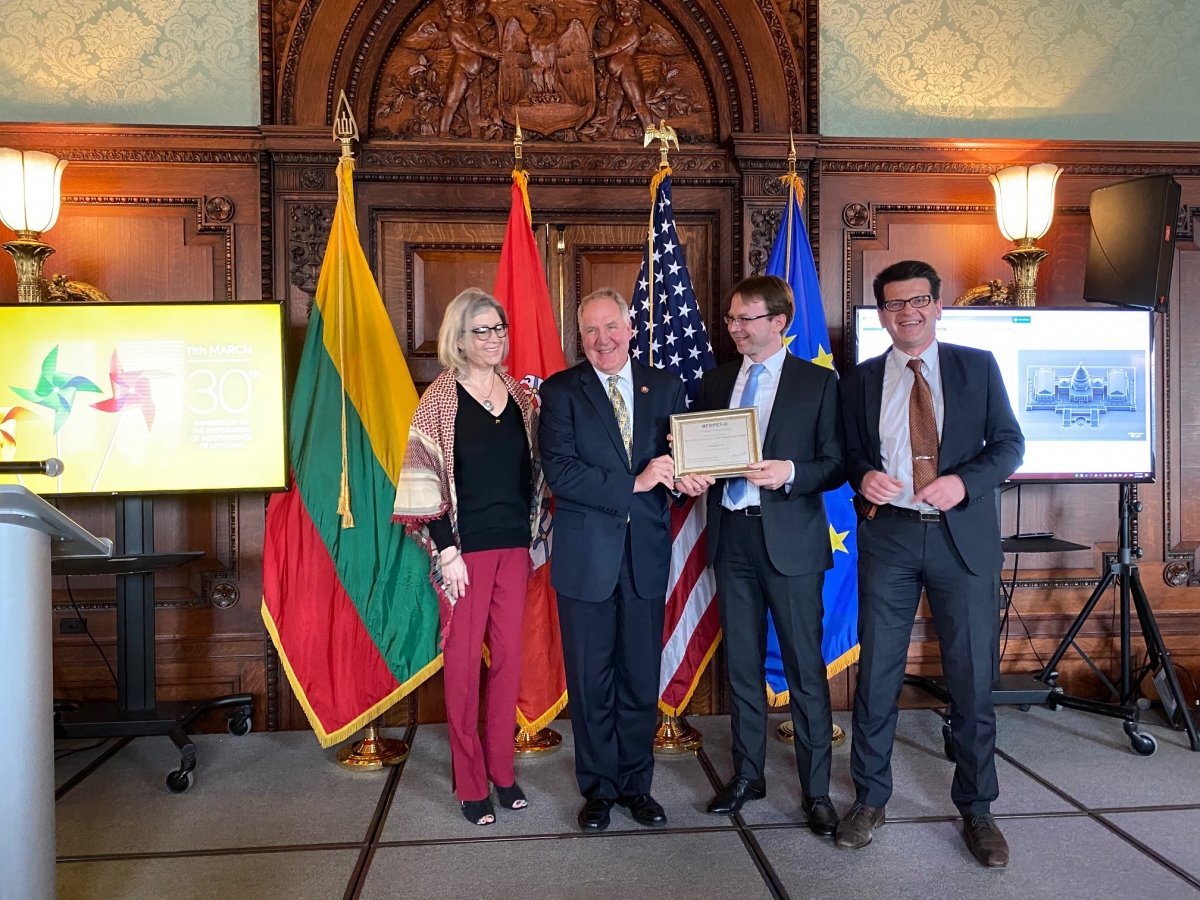


It took three months for Lithuanian scientists to develop a nanocopy of the U.S. Capitol Building, which is around 600,000 times smaller than its actual. A nano copy of the Statue of Freedom, the crowning feature of the Dome of the Capitol, is 10 times smaller than a human cell. "A small gift, but it represents the great friendship between Lithuania and America which is based on shared values and a love of freedom," says the Lithuanian Ambassador to the United States, Rolandas Kriščiūnas. The Ambassador presented this gift to Representative John Shimkus (R-IL), co-chair of the House Baltic Caucus, and a member of the Smithsonian Institution Board of Regents, and to Anthea M. Hartig, the Director of the National Museum of American History. The presentation ceremony took place during Lithuania’s Independence Day celebration at the Library of Congress on March 11. On this day, Lithuania celebrates the 30th anniversary of its restored Independence.
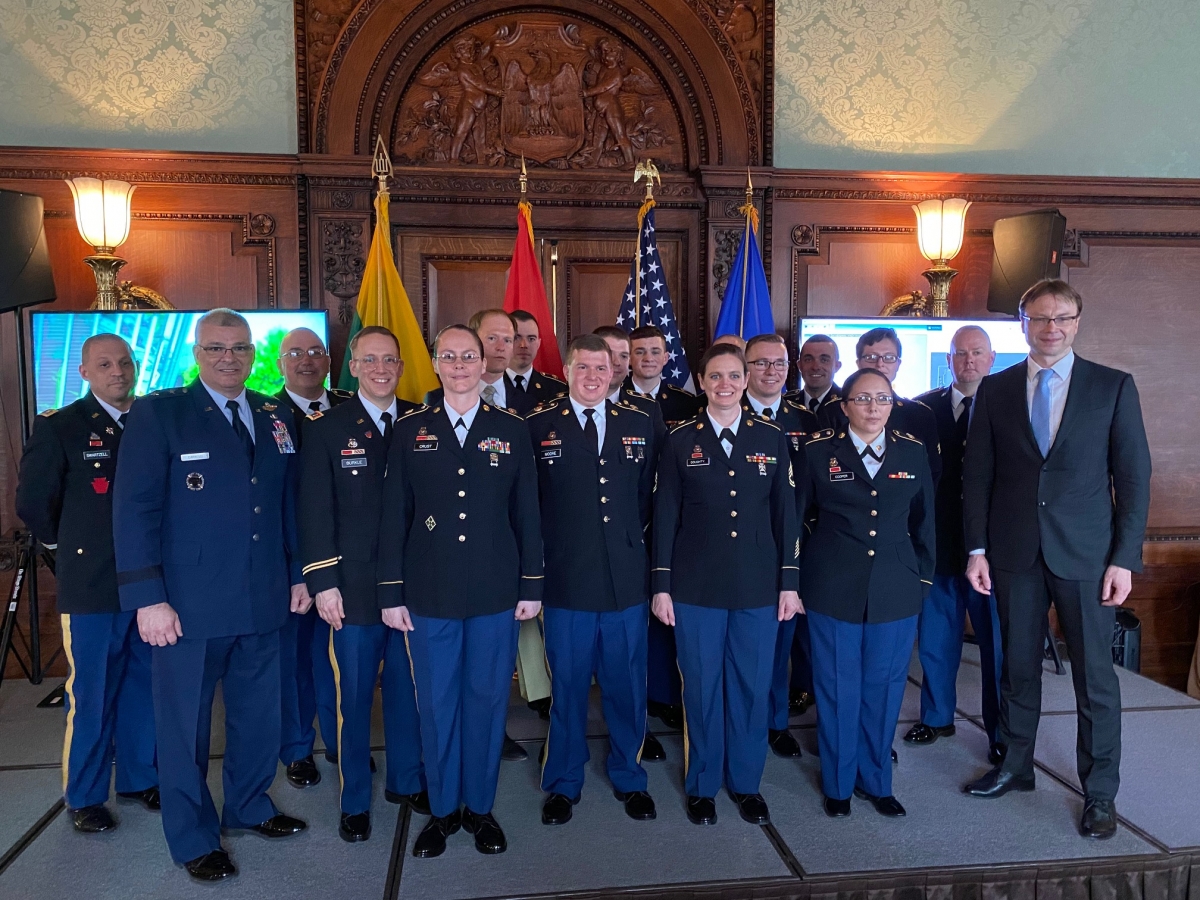
Senator Richard Durbin, Representatives Don Bacon (NE) and Mario Diaz-Balart (FL) were also present at the ceremony which featured the Pennsylvania National Guard Orchestra.
The nano copy of the Capitol Building will be in the disposition of the Smithsonian Institution. Ambassador Kriščiūnas hopes that Americans will have the opportunity to see this gift not only in the Nation’s Capital, but in other U.S. states, too. One would need a microscope for that, however.
"This is our symbolic way of thanking Americans for their support of Lithuania's freedom over the entire course of our bilateral history. This gift also shows how much talent and creativity is unleashed when people live in free societies. Over the past 30 years, many amazing things have happened in Lithuania, and we want to share our success stories with the world," says the Ambassador.
The nano copy of the U.S. Capitol Building is so small that it can fit into the eye of a needle. With an overall height of just 0.15 mm, it looks like a small dust particle on a glass surface. However, a quick glance with a powerful enough microscope reveals a printing resolution down to few hundred of nm, a size comparable to the wavelength of visible light. It allows superb detail of the building to be preserved even at such a small size. This is made possible by great know-how in areas of precision engineering, materials science, and ultrafast laser technologies.
Lithuania, a country of 3 million people, is one of the world’s leaders in laser technologies. Lithuania exports lasers to over 70 countries around the world. Ninety of the top 100 world universities use lasers produced in Lithuania, as does NASA, CERN, and such companies as IBM, Hitachi, Toyota, and Mitsubishi. Currently, Lithuanian laser companies have createdone of the most powerful lasers in the world, the so called Extreme Light Infrastructure-Attosecond Light Pulse Source (ELI-ALPS), which is being developed in the European Union. Lithuanian lasers were used in the production of the nanocopy of the U.S. Capitol Building.
The nano copy of the U.S. Capitol Building was created by a Lithuanian company, Femtika, which is a spin-off from the Vilnius University Laser Research Center. The company works in the area of laser micro-machining and can produce products from a mili-to-nano scale. Interesting applications of Femtikatechnology include micro-robots for traveling in human veins, a flow meter built inside a medical needle, and self-cleaning metal surfaces.
Photo: On the stage from the left to the right: Director of the National Museum of American History Anthea M. Hartig; Rep. John Shimkus, Ambassador Rolandas Kriščiūnas, Director of Femtika Vidmantas Šakalys.